Tuesday, March 19, 2013
Wikipedia & Learning
I feel pretty conflicted about Wikipedia. I use it almost daily to quickly look up information, for use in school (basic facts about everyone and everything, from Antigone to zebras) and at home (TV episode guides, definitions, and much more). I've edited articles (and am apparently one of few women who have done so). So I feel terrible that I have to tell students over and over again that they can't use it in academic writing--particularly because I know the editing community is pretty good at catching errors! Just check out the revision history of a controversial article and search for vandalism; errors are sometimes found and reverted instantly by the site's and eagle-eyed editors. Here's the past 500 edits of the article about Barack Obama, for an example.
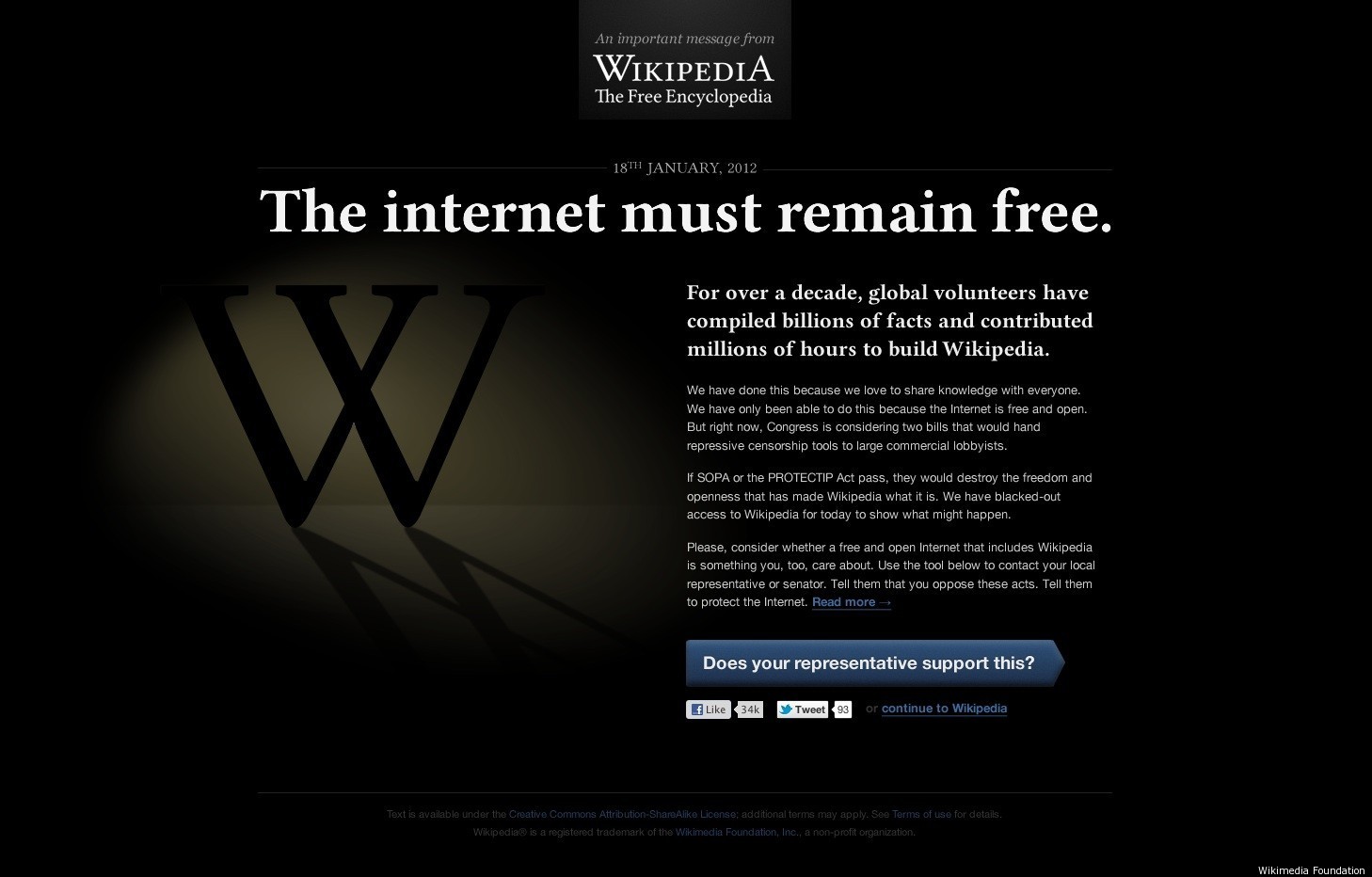
When the site blacked out in early 2012 in protest of SOPA/PIPA, I definitely noticed. I felt inconvenienced. But I worried more about what would happen if those bills passed. The idea that "Information wants to be free" is, to me, at the very heart of what we do as educators: we democratize learning by sharing what we know with our students, at no cost to them. I love that the internet provides access to information at little/no cost to people around the world.
Yet we have to train our students how to curate information for themselves. We will not always be there to provide resources for them. So, I'd really like to use this course to focus on how to effectively impart what the Partnership for 21st Century Skills calls Information, Media and Technology Skills. It is incumbent on me, as an educator, to teach students how to evaluate source credibility, author or organization bias, and usefulness of information. I learned these skills through experimentation and, as an undergraduate journalism major, through formal training from my own teachers. I don't want this to be left to chance for anyone else. I am committed to showing my students how to exploit their enviable access to information, gather and sift through their findings, determine what is useful, and manipulate it to maximum effect. My goal: for students to know exactly when they should look for things on Wikipedia, and exactly when they shouldn't. For students to know how to perform advanced Google searches that allow them to exclude commercial results. For students to understand that websites they visit may be biased--and identify which ones are. For students to be able and willing to go beyond Google and Wikipedia when they have to. And for students to become passionate about finding, taking in, and transforming information in order to express their own new and innovative ideas.
Tuesday, March 12, 2013
My Goals for the Course
I consider myself to be pretty skilled with technology, so I'm hoping to take this course as an opportunity to really drill down into why I should be using technology in my classroom, and how it will improve student learning. I do see it increasing efficiency for certain activities but it is hard to keep kids organized when they have multiple web accounts, untitled and "loose" Google Docs (i.e., docs that are not placed in folders), notebooks, and handouts to keep track of. I would like to explore ways to help kids improve their own organization, and perhaps help myself too. My Diigo bookmarks, for example, are using far too many tags. I need to simplify, and I need to help kids simplify!
For specifics, I'd like to learn more about Moodle, as a possible replacement for my Google Site. I'd like to branch out into technology that is more involved OR uncomfortable for me, including ways to flip the classroom. And I'd like to use technology more to have kids interacting with each other. I have students blogging this year, but I want them to read each other's blog. I need help figuring out the logistics to do that. Lastly, I use Evernote to save my lesson plans, but I want to explore whether it would be a good platform to share class notes with my students. It is possible that Moodle will obviate both my Google site and student notebooks in Evernote, though I won't know this until I try. I'm hoping to draw on the expertise of colleagues as I figure it all out.
Finally, I'd like to see students on task when their laptops are open because I have given them such a compelling assignment that they can't help but want to do it. Since not every student will be engaged in every lesson or activity, this may be somewhat of a pipe dream, but I am hopeful that students will use their laptops for learning, rather than gaming, shopping, or chatting with their friends during class. I think this course will guide me toward discovering new ways to engage students.
For specifics, I'd like to learn more about Moodle, as a possible replacement for my Google Site. I'd like to branch out into technology that is more involved OR uncomfortable for me, including ways to flip the classroom. And I'd like to use technology more to have kids interacting with each other. I have students blogging this year, but I want them to read each other's blog. I need help figuring out the logistics to do that. Lastly, I use Evernote to save my lesson plans, but I want to explore whether it would be a good platform to share class notes with my students. It is possible that Moodle will obviate both my Google site and student notebooks in Evernote, though I won't know this until I try. I'm hoping to draw on the expertise of colleagues as I figure it all out.
Finally, I'd like to see students on task when their laptops are open because I have given them such a compelling assignment that they can't help but want to do it. Since not every student will be engaged in every lesson or activity, this may be somewhat of a pipe dream, but I am hopeful that students will use their laptops for learning, rather than gaming, shopping, or chatting with their friends during class. I think this course will guide me toward discovering new ways to engage students.
Subscribe to:
Posts (Atom)